

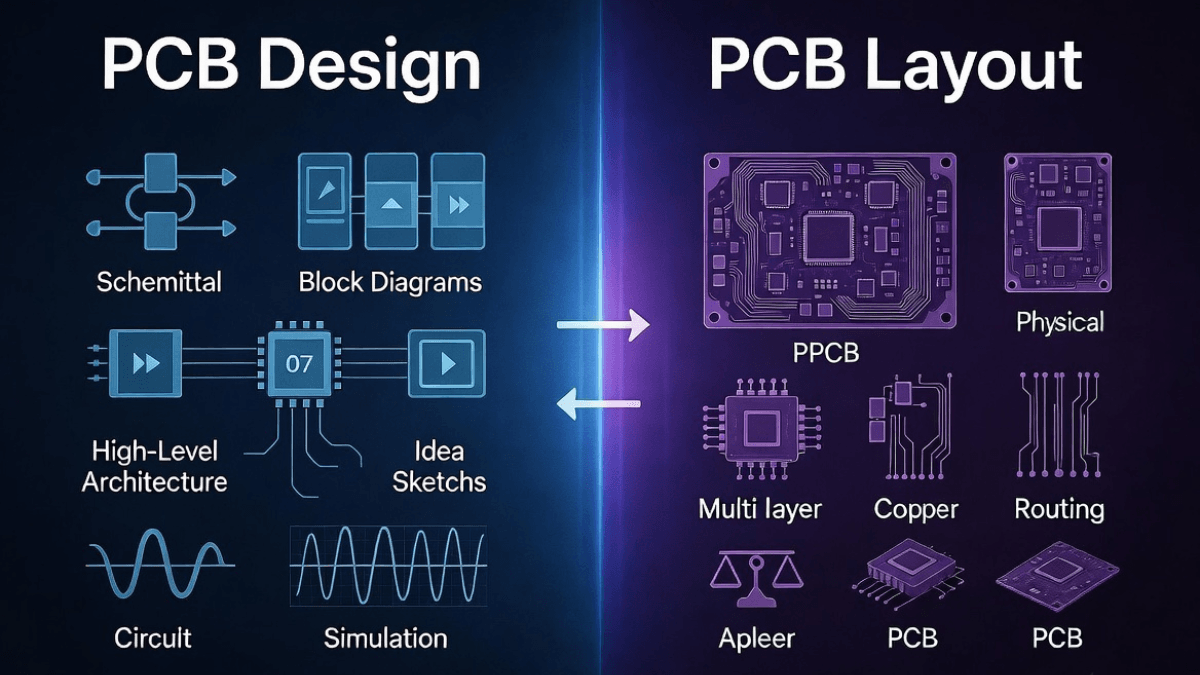


If you have ever found yourself using “PCB design” and “PCB layout” interchangeably, you are not alone. These terms are often used as synonyms in casual conversation, but in the world of electronics engineering, they represent two distinct and complementary disciplines. The difference between PCB design vs PCB layout trips up more engineers than you would expect, and the gap between them is where many projects quietly go sideways .
Understanding the distinction between PCB design vs PCB layout is not just a matter of semantics. It is a practical necessity that can save your project from costly mistakes, delayed timelines, and failed products. Simply put, PCB design vs PCB layout can be understood as the difference between the “soul” and the “body” of your electronic device . A flawless schematic can fail in production due to poor layout, and even the best layout engineer cannot rescue a fundamentally flawed design .
In this guide, we will break down the distinctions between PCB design vs PCB layout, explore each phase in detail, and help you understand why both are essential for successful product development.
What Is PCB Design?
PCB design is the architectural phase of electronic product development. It is where abstract electrical theory is translated into a logical blueprint. Before any physical trace is routed, this stage establishes the functional foundation of the device, focusing entirely on circuit logic and electrical integrity .
The Core Elements of PCB Design
1. Functional Planning and Requirements Definition
Every design begins with defining what the circuit should achieve. Designers translate product specifications into electrical requirements, such as voltage levels, current capacity, and signal integrity targets .
2. Schematic Capture
This is where the circuit takes visual form. Using schematic capture software like Altium Designer, KiCad, or OrCAD, engineers create a detailed diagram showing how components connect. Each symbol carries electrical parameters, and nets represent logical connections that become routing paths later .
3. Component Selection
Choosing the right components is a critical skill. Designers must balance:
- Performance: Will this component meet the required specifications?
- Availability: Is the part in stock or at risk of supply chain shortages?
- Cost: Can the design stay within budget while maintaining quality?
- Footprint compatibility: Does the schematic part match a real-world package size?
4. Electrical Performance Considerations
Even at this early stage, designers think about:
- Signal integrity – avoiding crosstalk, reflections, and EMI
- Power delivery – ensuring stable voltage rails
- Thermal management – heat dissipation for regulators and MOSFETs
The Output of PCB Design
The primary outputs of PCB design are:
- Schematic diagram – a graphical representation of the circuit
- Bill of Materials (BOM) – a comprehensive list of all components
- Netlist – a machine-readable “map” that tells layout software which physical pads must be joined
Think of PCB design as the architect’s blueprint. It defines what needs to be built, but it does not specify how every physical detail will be constructed.
What Is PCB Layout?
If PCB design is the blueprint, then PCB layout is the construction process. PCB layout is the physical implementation of the design contract. It is where abstract electrical logic meets real-world physics, geometry, and manufacturing constraints .
The Core Elements of PCB Layout
1. Component Placement
The very first step in layout is deciding where each part goes on the board. Placement is not random—it affects everything from performance to cost :
- Function-based grouping: Place related parts together
- Signal flow: Arrange components so signals move logically across the board
- Thermal considerations: High-power parts need open space for cooling or heat sinks
- Manufacturing constraints: Components must follow spacing rules for automated soldering
2. Routing
Once components are placed, designers draw traces to implement the schematic:
- Width and clearance: Power traces need to be wide enough to carry current; signal traces need spacing to avoid crosstalk
- Controlled impedance: High-speed signals require specific trace characteristics
- Layer management: Multi-layer PCBs enable routing on multiple layers
- Via usage: Vias add flexibility but increase manufacturing cost
3. Design for Manufacturability (DFM)
Even a beautiful layout can fail if it cannot be produced efficiently. Layout engineers always check:
- Minimum trace width and spacing against fabricator capabilities
- Drill hole sizes and tolerances
- Copper balance to prevent warping
- Assembly rules for automated soldering
4. Thermal Architecture
The layout phase includes designing thermal paths, thermal vias, and copper pours to maintain components at safe operating temperatures .
The Output of PCB Layout
The primary outputs of PCB layout are:
- Gerber files – manufacturing instructions for each layer of the PCB
- Drill files – specifying hole sizes and locations
- 3D layout files – for mechanical integration
These files provide the detailed information necessary for manufacturing a functioning PCB.
PCB Design vs PCB Layout: Key Differences at a Glance
| Aspect | PCB Design | PCB Layout |
|---|---|---|
| Definition | Logical planning of connections | Physical placement and routing |
| Main Objective | Circuit functionality | Reliability and manufacturability |
| Key Tasks | Schematic capture, component selection | Stack-up design, routing, DRC |
| Tools Used | KiCad, Altium Schematic, OrCAD | Altium PCB, Allegro, PADS |
| Input | Requirements, datasheets | Netlist, board dimensions, BOM |
| Output | Schematic, netlist, BOM | Gerber files, drill files |
| Focus | Electrical logic | Signal integrity, thermals, DFM |
| Expertise | Electrical Engineering (EE) | PCB Designer / CAD Specialist |
Why the Distinction Between PCB Design vs PCB Layout Matters

Understanding the difference between PCB design vs PCB layout is not just academic—it has real-world consequences for your product development.
The Cost of Confusion
If your schematic has errors—wrong pin assignments, missing power connections, bad component choices—the layout engineer cannot fix them by clever routing. The board simply will not work .
Conversely, a perfect schematic can still become a failed product if the layout has:
- Poor trace routing causing signal integrity issues
- Bad thermal design leading to overheating
- Violations of manufacturing rules driving up costs
The Interdependent Workflow
In practice, PCB design vs PCB layout should be viewed as two halves of one job . They form an interdependent, continuous workflow that should be planned together in the project schedule .
Key points to remember:
- Design defines what the circuit should do – it answers “does it work logically?”
- Layout defines how the circuit is built – it answers “can it be built reliably and stay cool?”
- Both must be correct for a successful product
- Communication between design and layout teams is essential
1. Real-World Example: PCB Design vs PCB Layout in Action
A Practical Example of PCB Design vs PCB Layout
To truly understand the difference between PCB design vs PCB layout, consider a simple example. Imagine you are designing a temperature monitoring device for an industrial environment.
The PCB Design Phase:
- The design engineer selects a microcontroller, temperature sensor, and communication interface
- A schematic is created showing how these components connect electrically
- The engineer specifies that the sensor uses an I2C bus running at 400 kHz
- Power requirements are defined: 3.3V supply with appropriate decoupling capacitors
The PCB Layout Phase:
- The layout engineer places the microcontroller and sensor close together to minimise trace length for the I2C bus
- Traces are routed with proper width and spacing to maintain signal integrity
- A dedicated ground plane is created underneath the sensor for noise isolation
- Thermal vias are added under the power regulator to dissipate heat
This example shows how PCB design vs PCB layout represents two complementary skill sets working toward the same goal: a functional, manufacturable product.
2. Why Both PCB Design and PCB Layout Are Critical for Product Success
Why Both Aspects of PCB Design vs PCB Layout Matter
The distinction between PCB design vs PCB layout is not about choosing one over the other. Both are critical for product success, and understanding this helps you make better decisions about resource allocation.
When PCB Design Excellence Alone Is Not Enough:
- A brilliant schematic can be rendered useless if the layout introduces signal integrity issues
- Component placement errors can make a board impossible to assemble
- Poor thermal design can cause field failures regardless of circuit quality
When PCB Layout Excellence Alone Is Not Enough:
- Even perfect routing cannot fix a fundamentally flawed schematic
- Wrong component selection cannot be corrected through clever placement
- Missing decoupling capacitors will cause noise issues regardless of trace routing
Understanding PCB design vs PCB layout helps you appreciate why both require dedicated expertise. The best products emerge when design and layout engineers collaborate closely throughout the development process.
3. How PCB Design vs PCB Layout Impacts Cost and Time to Market
The Impact of PCB Design vs PCB Layout on Your Budget and Timeline
The relationship between PCB design vs PCB layout directly affects your project’s cost and timeline. Understanding where to invest resources can significantly impact your bottom line.
Cost Considerations:
- PCB design errors identified during layout are 10x more expensive to fix than those caught during schematic review
- Layout issues discovered during production can cost 100x more to resolve than design-phase corrections
- Poor component placement increases board size, raising fabrication costs
- Inefficient routing can require additional layers, increasing material costs
Timeline Considerations:
- A solid PCB design reduces layout time by providing clear requirements
- Good layout practices reduce the need for multiple prototype iterations
- Early collaboration between design and layout teams prevents late-stage redesigns
By understanding PCB design vs PCB layout, you can allocate resources effectively and avoid costly delays.
4. The Evolution of PCB Design vs PCB Layout in Modern Electronics
How Technology Is Shaping PCB Design vs PCB Layout
Modern electronics are pushing the boundaries of PCB design vs PCB layout. As devices become faster, smaller, and more complex, the lines between design and layout are becoming increasingly intertwined.
Emerging Trends:
1. High-Speed Digital Design
- Signal integrity is now a design consideration, not just a layout concern
- Designers must specify controlled impedance requirements early
- Layout engineers use advanced simulation tools to validate designs
2. Miniaturisation
- Smaller components require tighter tolerances in both design and layout
- Component placement affects signal integrity more than ever
- Thermal management requires collaboration from both disciplines
3. Integration with Firmware
- Design and layout decisions affect firmware performance
- Timing constraints must be considered during both phases
- Collaboration ensures hardware-software co-optimisation
4. Advanced Simulation Tools
- Modern tools enable simulation during both design and layout phases
- Signal integrity simulation is now performed during layout
- Power integrity analysis influences both schematic and placement decisions
Understanding PCB design vs PCB layout in the context of modern electronics helps you stay competitive in today’s fast-paced market.
5. The Future of PCB Design vs PCB Layout
What Lies Ahead for PCB Design vs PCB Layout?
The distinction between PCB design vs PCB layout is evolving as technology advances. Here is what to expect in the coming years.
1. AI-Assisted Tools
- AI is beginning to assist with both design and layout tasks
- Automated routing and placement are becoming more sophisticated
- Design rule checks are becoming more comprehensive
2. Greater Integration
- The separation between design and layout is blurring
- Integrated tools allow seamless transitions between phases
- Collaboration between disciplines is becoming more important
3. Increased Complexity
- Higher speeds and smaller form factors demand closer collaboration
- Thermal and mechanical constraints influence both design and layout
- The gap between design and layout is narrowing
4. Skills Convergence
- Future engineers may need expertise in both disciplines
- Cross-training is becoming more common
- Understanding the full workflow is increasingly valuable
Understanding PCB design vs PCB layout prepares you for these trends and helps you make better technology decisions.
Common Mistakes and How to Avoid Them
In PCB Design
In PCB Layout
Why Waferlabs Excels in PCB Design and Layout

At Waferlabs, we understand that PCB design vs PCB layout is not a competition—it is a partnership. Our engineering team includes professionals who have worked at Intel, Broadcom, Qualcomm, and Microsoft, bringing decades of collective experience to every project.
Integrated Approach
We treat PCB design and PCB layout as two halves of one job. Our engineers handle the entire flow—from reviewing or creating your schematic all the way through layout, DFM optimisation, and generating production-ready files .
Research-Driven Methodology
We do not take shortcuts. Our research-driven approach ensures that every design is optimised for performance, cost, and manufacturability. We stay at the forefront of emerging technologies so that our clients benefit from the latest innovations.
End-to-End Capabilities
Beyond design and layout, Waferlabs provides complete turnkey project delivery. This includes hardware design, PCB layout, prototyping, firmware development, assembly, testing, and manufacturing support. Having everything under one roof eliminates integration problems and accelerates your time to market.
Proven Track Record
Waferlabs serves startups, Fortune 500 companies, and enterprises across multiple industries, including telecommunications, automotive, consumer electronics, healthcare, and industrial automation.
Conclusion
PCB design and PCB layout are two distinct but interconnected disciplines that together determine the success of your electronic product. PCB design vs PCB layout is not a question of which is more important—both are essential.
Key takeaways:
- PCB design is the logical foundation—defining what the circuit should do
- PCB layout is the physical implementation—determining how it is built
- A flawless schematic can fail due to poor layout
- The best layout cannot rescue a flawed schematic
- Both must work together for successful product development
Understanding these distinctions helps you:
- Make better decisions about resource allocation
- Communicate more effectively with engineering partners
- Avoid costly mistakes that delay time to market
- Build better products that perform reliably
At Waferlabs, we bring together expertise in both design and layout, ensuring that your product is built on a solid foundation from concept to manufacturing. “A place where ideas meet technologies” reflects our commitment to helping clients turn their visions into reality.
If you are ready to take your product from concept to production, we would love to partner with you. Let us show you how integrated PCB design and layout services can make all the difference.
Frequently Asked Questions
1. What is the difference between PCB design and PCB layout?
PCB design is the logical and electrical phase of development, focusing on creating the schematic, selecting components, and defining circuit functionality. PCB layout is the physical phase, focusing on component placement, trace routing, and ensuring manufacturability. In short, PCB design vs PCB layout is the difference between the blueprint and the construction plan .
2. Can the same person handle both PCB design and layout?
Yes, individuals with a broad skill set may handle both phases. However, larger projects often involve specialised roles for each phase due to the different skill sets required. PCB design requires deep understanding of circuit theory and component selection, while layout requires expertise in CAD tools, signal integrity, and manufacturability rules .
3. What tools are used for PCB design vs PCB layout?
PCB design tools include schematic capture software like Altium Schematic, OrCAD Capture, and KiCad. PCB layout uses physical design tools like Altium PCB Editor, Cadence Allegro, and Mentor Graphics PADS .
4. What are the outputs of PCB design and layout?
PCB design outputs include the schematic diagram, bill of materials (BOM), and netlist. PCB layout outputs include Gerber files, drill files, and 3D layout files used for manufacturing .
5. How does PCB layout impact manufacturing costs?
PCB layout directly influences manufacturing costs by affecting material usage, production efficiency, and manufacturing complexity. Poor component placement can increase board size, while routing decisions affect layer count and fabrication difficulty .
6. Why is understanding PCB design vs PCB layout important?
Understanding the distinction helps you plan projects effectively, allocate the right resources, communicate clearly with engineering partners, and avoid costly mistakes. A flawless schematic can fail due to poor layout, and the best layout cannot rescue a flawed schematic .
7. What happens if there are errors in PCB design?
Errors in the schematic, such as wrong pin assignments or missing power connections, are invisible to layout tools. The layout engineer cannot fix these by clever routing—the board simply will not work. This is why thorough design validation is essential before layout begins .


